One of the most common pieces of advice you’ll hear about using AI is simple: “Give it more context.” Relevant context matters more than any single magic phrase — and the reason is less about feeding the AI more information than about helping it understand the problem it is trying to solve.
Context does more than inform. It constrains.
Imagine I ask an AI: “Write a presentation about leadership.”
There are countless ways it could respond. Should it be formal or conversational? Is the audience high school students or senior executives? Should it focus on military history, business, sports, or volunteer organizations? Should it last five minutes or an hour?
None of those questions have been answered. From the AI’s perspective, there are an enormous number of responses that could satisfy the request.
Now consider a different prompt.
“Write a ten-minute presentation for first-time restaurant managers supervising six employees. Use plain language, include one story about making a difficult decision, and end with three practical ideas they can use on their next shift.”
The request is longer, but now it defines the problem. Every detail narrows the range of useful answers. The AI has a clearer target: a response that fits the constraints you’ve established.
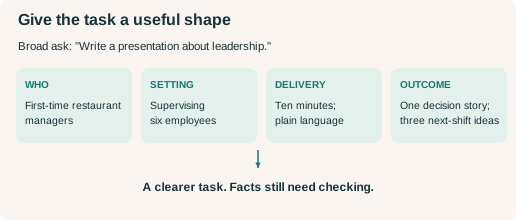
Audience, setting, duration, and desired outcome give the leadership presentation a clearer target. Relevant constraints improve task definition; factual checking remains necessary. Conceptual diagram created with Codex for Renaissance Solutions. CC0-1.0.
I experienced this while developing our AI Learning Lab. Early on, I asked the AI to suggest a module about context. The response was perfectly reasonable, but generic.
Once I explained that the Learning Lab teaches durable mental models rather than prompt tricks, and that the audience is curious professionals rather than AI specialists, the conversation changed completely.
Instead of producing another list of prompting tips, the AI helped develop the idea that context matters because it defines the problem through constraints. The answer was not simply better written. It was solving a more useful problem.
This is a familiar lesson
Most of us already understand this in other parts of life. If you ask someone to plan a meal, the answer changes when you mention how many people are coming, dietary needs, budget, and time. Those details do not make cooking less creative. They give creativity something useful to work with.
Planning a trip, a meeting, or a school project works much the same way. Constraints are not always barriers. Often, they are what give a good answer shape.
AI benefits from the same kind of clarity. Relevant context gives it a direction.
Not all context is helpful
This is where many of us stumble. Once we hear that context helps, the natural reaction is to include everything we can think of: meeting notes, old emails, background stories, unrelated requirements, and details that have nothing to do with the task at hand.
More information is not automatically better information. Useful context helps define the problem. Irrelevant context can widen the problem, introduce conflicting signals, or simply create noise.
Give the AI information that helps define what success looks like. Details that don’t define success often act as noise that might lower the quality of the result.
A useful mental model
One useful everyday model is that a conversation gives the AI a set of constraints for what a fitting response should look like.
Those constraints come from many places:
- Your request
- Earlier parts of the conversation
- Documents you’ve shared
- Goals you’ve stated
- Writing style you’ve requested
- Facts you’ve already established
- Instructions you’ve provided
An AI does not literally consider every possible answer one by one. But this model captures a familiar experience: relevant details make it more likely that its response will fit the job you have in mind. The result can feel like better reasoning because the task itself is clearer.
This is not a complete explanation of how modern language models work. It is a practical model for everyday users, and it explains a great deal about why context matters.
What stays human
A clearer request is still not a guarantee that every fact in the answer is right. Important work still deserves a human check.
It also explains why people get different answers
One of the most common questions people ask is: “Why did my friend ask the same AI the same question and get a completely different answer?”
Often, they did not ask exactly the same question. Even if the final prompt was identical, the conversations leading up to it may have been very different. There is no mysticism here:
- Previous context shapes future responses.
- Different constraints lead to different useful answers.
- Different conversations can produce different results.
The lesson isn’t really about prompting
As AI tools become more capable, I suspect we’ll spend less time talking about prompt engineering — crafting clever prompts — and more time talking about problem definition and constraints.
The most effective AI users aren’t always the people who have memorized the most prompt tricks. They’re the people who define problems clearly, provide relevant context, and know how to evaluate and refine the results.
These users know it is about making the problem clearer. They:
- understand the problem they are trying to solve.
- know which constraints matter.
- know which details are distractions.
- know that adding context is not about making a prompt longer.
That is an invitation, not a new rule to memorize. On your next real task, start with the outcome you want, who it is for, and anything that must remain true. Then add the information that helps define the work and see what changes.
You do not need magic wording. You only need to give the AI a real problem it can help with.