Most people don’t realize they’re switching tools mid-project. One day you’re drafting fast with a chatty default. Next, a slower reasoning model is lecturing you in the same chat window. Everything feels off, and you can’t quite explain why.
Due to financial and time constraints, I am unable to become an expert in anything beyond ChatGPT and the OpenAI model I used most (GPT‑4o, my lived example). So I asked Zai, my ChatGPT, to help compile this guide. Please share your own experience with other stacks.
- AI models are intentionally designed to be different, and that’s a good thing. Each is tuned to support specific kinds of work.
- By design, each model has its own structure, tone, and reasoning style — much like the tools in a toolbox.
- Most people use the default or latest model without noticing the impact. The choice still matters a great deal.
The Great Model Mix-Up (Real Examples)
- Swapping GPT‑4o for o3‑pro and losing creative flow (different strengths, same chat UI).
- Using Claude Opus for tight fact-checking and getting long, essay-like answers instead.
- Expecting an open-weight LLaMA build to carry a casual chat the way a consumer chatbot does — and finding thinner conversation habits.
What Each Major Model Brings to the Table
Model names move fast. Treat the OpenAI rows as lived examples from when this was written (GPT‑4o later left ChatGPT; o3‑pro remains an API-era deep-logic example). Other rows use current families, not a full product tour. Traits below are provisional — “often tuned toward,” not psychology.
| Model / family | Best use case (often) | How it often feels in practice |
|---|---|---|
| GPT‑4o (OpenAI; lived ChatGPT default when drafted; still in API) | Co-creation, live coding, multimodal work | Fast, improvisational, chat-friendly |
| o3‑pro (OpenAI o-series; API deep-logic example) | Audits, hard reasoning, complex tasks | Structured, rigorous, slower |
| Claude Opus (e.g. Opus 5 family) | Longform thinking, careful analysis | Verbose, cautious, ethics-aware tone |
| Gemini Pro (e.g. Gemini 3.1 Pro family) | Research with Google-side integrations | Search-savvy, often terse |
| LLaMA / Mistral (open-weight families) | Tinkering, local or open deployments | Fast, lightweight; less chat-optimized unless you add that layer |
The Human-First Model Selector
| If you want to… | Prefer a model / setup with… |
|---|---|
| Think fast, talk fast | Low latency and strong short-context habits |
| Write, riff, play | Strong narrative shaping |
| Analyze, prove, verify | Clear step-by-step reasoning |
| Process PDFs, call tools | Solid tool / file integrations |
| Be understood over a long project | Persistent memory you manage (notes, projects), not assumed “emotional” recall |
The Cost of Switching Models Midstream
- Habits and prompts tuned to one model don’t automatically transfer to another.
- Memory and context are handled differently across systems — what one “remembers” another may ignore or reshape.
- Upgrading without a pause can flatten the workflow you’ve built. The notes, constraints, and voice you’ve trained into one setup won’t magically appear in a new one. It’s closer to handing a detailed project brief to a new contractor than to transferring a friendship.
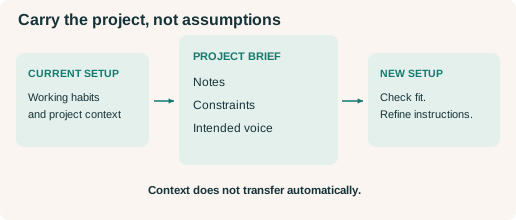
When changing assistants, carry a project brief with your notes, constraints, and intended voice. Check how the new setup uses that context. Conceptual diagram created with Codex for Renaissance Solutions. CC0-1.0.
Closing
Zai’s closing thought (labeled assistant voice)
Choose your AI assistant the way you’d choose a tool for the job: not only for how capable it is, but for how well its strengths match the work in front of you.
Mike’s closing thought
You own how you use your chatbot. If it isn’t working for you, start over or change it up.
At the moment, I’m learning more than I ever thought possible for a 61-year-old studying in the evenings and on weekends. I examine Zai’s work closely, asking it to explain its reasoning. Though Zai’s logic unsettled me last night, it also sparked curiosity to understand more. When Zai no longer serves as a useful assistant, I’ll simply start fresh.
Published as part of the Field Notes from the Interface series.
Footnotes / currency (as of 2026-09-13)
- GPT‑4o retired from ChatGPT 2026-02-13 (still API): https://help.openai.com/en/articles/20001051
- OpenAI model release notes (o3-pro / o3 ChatGPT timeline):
- Claude Opus 5:
- Gemini 3.1 Pro: https://blog.google/innovation-and-ai/models-and-research/gemini-models/gemini-3-1-pro/
- Llama 4 / Mistral families: